
.jpg)
Lazy Bear Lane
by Thorne Smith
Dedication
For My Daughters — June and Marion
In memory of Cabane Bambou and a Lazy Bear with a Lively Squirrel wandering now in spirit among the pines of Esterel Plage. Also for all other nippers who like slightly peculiar animals and people with just a touch of magic to help the author out of difficult situations.
Chapter One
The Unwanted House
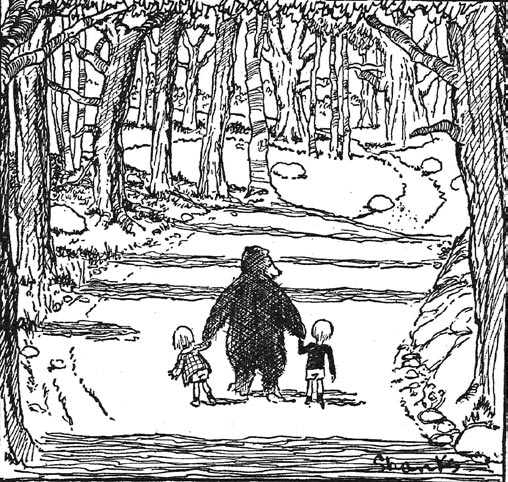
Peter and Mary lived in the little old house. It was a square house and not at all interesting. To Peter and Mary it had never been interesting. And what's more, it never would be interesting.
It was just like having too much of something you didn't want or wanting too much of something you didn't have — and never could get.
It was a house that nobody wanted.
And Peter and Mary could not find it in their hearts to blame anyone for not wanting the house. They didn't want it themselves.
Certainly not. Why should they?
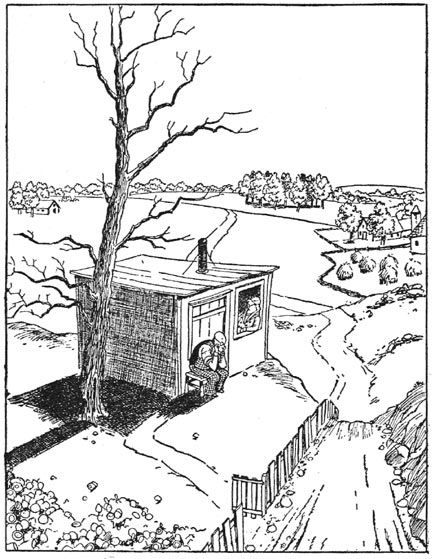
Even the field mice, who were not at all particular about the houses they visited, turned up their noses at the house in which Peter and Mary lived. Of course the field mice might have done this because there were never any refreshments in the house to make a visit worth the time and trouble, but for all that it does not make you feel any better to have a field mouse turn up its nose at your house. And you don't have to be so very fond of field mice to feel this way about it, either. It's just a feeling you get.
"The least they could do," complained Peter to Mary one Thursday in August, "would be to creep in and take a quiet look about on the off chance that just possibly there might be a little something worth nibbling."
"And if one ever found anything," she replied, "it would be that field mouse's last meal. The poor thing would never leave this house alive. You'd fight for that nibble to the bitter end."
"And why not?" asked Peter. "If it's a mouse's life against mine, I intend to do my best."
But no. It seemed to be generally understood among local field mice that there was never anything worth nibbling in that house.
"Never waste your time on it," one old dowager field mouse kept reminding her grandchildren, her great-grandchildren, and incidentally her great-great grandchildren. "It's not that they don't know how to set a good table, but they never have anything to set, the poor dears. Just a table, and not much of a table at that. I'm sure I don't know how those two old people ever manage to keep body and soul together."
This so worked upon the sympathies of a certain young field mouse that one day when it found a nice piece of cheese in a rich man's pantry it nearly brought it to Peter and Mary. It nearly did so, but while thinking of how much they were going to enjoy it, the little fellow grew so excited that it ate the cheese all up. The heart of the little field mouse was in the right place, but unfortunately, so was its stomach. And that's where the cheese went.
So the field mice kept away from the house. Not even passing tramps came to the back door to beg for food. There was just as much back door to the house as there was food inside it, which means there wasn't any back door at all.
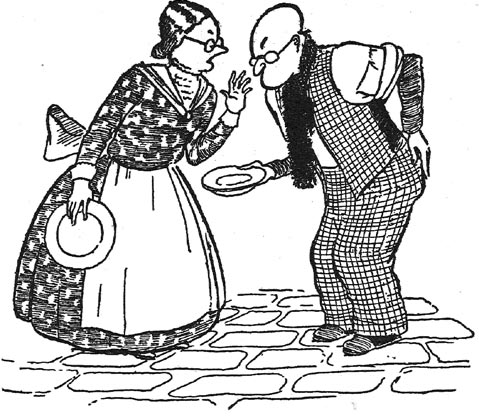
This made no difference anyway. The moment a tramp set eyes on the house, he would lose his appetite. This, in a way, was a good thing because the tramp wasn't hungry any more, which is nearly as good as having had a delicious dinner, but not quite so good. The tramp would go away without his appetite but also without the pleasant memory of having tasted anything nice to eat. This would make him feel puzzled, and tramps hate to feel that way because it makes them tired, which they always are anyway, so after all, perhaps it made no difference. Anyway, it doesn't matter. Not much.
To begin with, no magic could ever happen to such a house. Peter and Mary were sure of that. This was one of the reasons why they had never been so fond of the house. Both Peter and Mary, as old as they were, still believed in magic and had believed in it through all the long years of their lives. Every day and every night they had hoped for magic, but so far no magic thing had ever happened to them.
Magic had passed them by.
On this day, Mary was looking out of the window.
She could see nothing much but sun-baked mud and old tin cans. She had seen those same old tin cans so long that she knew them all by heart. That is, she knew exactly where each one of them lay and just how many there were. Peter refused to look at them, because they made him even more hungry than he was. There was nothing green near the house, no grass or bushes, but far off Mary could see tall trees, rolling fields, and green hillsides. They were happy places to be in, cool, amusing places, but the rich farmers and their families lived over there.
And as Mary looked she was thinking of the days when she and Peter had green fields and trees around them and a nice house of their own. And somehow the old smile would not come back to her lips when she turned to look at her husband, for in her heart she was sad and wanting a bit of a change for both of them.
Peter was sitting cheerfully on his stool. He was cheerful because he was making up a poem about the house. He never grew tired of doing this, because it always made him feel better.
Mary listened to him as he announced in a loud voice:
The Unwanted House
By Peter
"This house is only a box —
Oh, dear, what a horrible house! —
It will fall if anyone knocks,
It's too bare for even a mouse.
"This house has only one room,
So it's easy to keep the place neat.
There is no space for a broom —
It's nearly too small for our feet.
"This house has nothing on top.
There isn't even a cellar.
Wherever you go you must stop —
It simplifies life for the dweller.
"There is nothing to carry or fetch.
A stamp would carpet the floor.
My legs, whenever I stretch,
Must wait till I've opened the door.
"My wife, my silly old spouse,
Is feeble and foolish and lame,
She brought me to live in this house.
I hold her entirely to blame."
There is no telling how long Peter would have kept on with this poem if Mary had not interrupted him.
"Listen to me, old, old man," she said, "it's time we were thinking about supper."
"Very good," replied Peter, agreeably. "Let's think about supper." So Mary sat down opposite Peter on another stool and both of them thought about supper, which was quite easy to do because there was no supper to think about.
"I'm all tired out thinking about supper," said Peter at last. "Let's think about no supper. That's much more reasonable. I'm no good at thinking about something that isn't. How do you do it?"
"You just keep on thinking until it is," said Mary, "or until you see that it's going to stay isn't or not."
"Do you mean," asked Peter, "that if I sat here and kept on thinking of a nice beef stew for supper we'd really have that stew?"
"If you had any brain to think with," said Mary, and added, "but you haven't."
Now, while Peter was thinking, he was looking at the pages of a seed catalogue. In this book there were lovely pictures. There were pictures of big red tomatoes, pearl white onions, and slim golden carrots. On another page there were pictures of spinach and peas and beans and ears of corn all in their real colors.
And Peter kept looking at these pictures so hard that he began to feel they really were real. They seemed to pop right out of the pages at him and to fall plop into his lap. It was wonderful — almost like magic.
Peter was paying little attention to Mary. He had lived so long with her that he knew the only way to stop her was to let her talk herself tired or until her face became quite blue from lack of breath. So instead of listening to her he got up from his stool and began to get busy.
"I'll make her a stew for supper," he said to himself. "I'll make her a delicious stew and I know just what I'll call it. I'll call this stew I'm going to make:
"Catalogue Stew
Created by Peter
Chief Chef of the
Unwanted House
(patent pending)"
Peter had no idea what the last part meant, the "patent pending" part, but he put it down because he had seen it somewhere and also because it made the whole thing sound more and better.
Peter was like that.