
.jpg)
Lost in the Horse Latitudes
by H Allen Smith
Illustrated by Leo Hershfield
Chapter 1
Concerning the Sex Life of Chickens
this is the Last chapter. I have yanked it out of its proper place and installed it here at the beginning because it was written before any of the others; because the book is so disorganized that nobody would ever notice the difference; but chiefly because a great many people always read the last chapter of a book first, even in mystery stories.
The lilting prose contained in this last chapter is being carpentered in an upstairs room of a farmhouse. Below the window at my right a man is standing in a wagon scattering some stuff over a field by means of a pitchfork. I'm not sure what he is scattering, but I can guess. I have seen stuff thrown with a pitchfork before but never have I seen a man throw it as this man does, he can throw stuff faster and farther than any person I know outside of Hollywood. He creates a fitting atmosphere for the beginning of this project; he inspires me to prodigious effort.
The reason I am sitting in a farmhouse is none of your business. If it were any of your business I might tell you that just recently I returned to New York City from Hollywood. I spent six months in the town Rufus Blair calls Double Dubuque and came pretty close to catching a disease known as the Beverly Hills botts -- an affliction characterized by gastrointestinal disturbances, skin eruptions that would frighten a barbecued ham, and whirring noises in the head. Along toward the end of my visit I found myself scanning the real estate ads and looking covetously at convertible coupes. If it hadn't been for the dove I think I might have taken up permanent residence in that lovely town.
One morning I got out of bed earlier than usual. I had intended sleeping late but outside the window of my apartment a dove was making dove noises. I shaved and dressed and all the while that maniacal bird kept up its melancholy hooting. I've always been under the impression that a dove had some association with tender feelings -- that the cooing of a dove was somehow romantic and inspirational, causing the giblets to vibrate. Now I know better. I stood it as long as I could, then flung open a window, poked out my head, and screamed;
"SHUDDUPPP!"
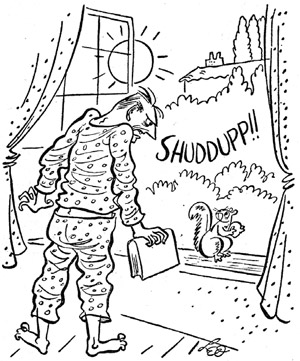
It didn't shut up, so I threw a copy of The Gay Illiterate at it and it went away for a while. Then I sat down and considered my conduct. "Heavens to betsy," I said to myself. "I'm probably the only person in the world who ever screamed in anger at a dove. It's time I got out of this place." And so I came back to New York City, fairly eager for work. At once a new crisis arose. A squirrel laid siege to my apartment. This squirrel apparently loves the sound of a typewriter and whenever he hears it he arrives on the run, plants himself on the window sill, and just sits there looking at me. It was amusing for a while but not a very long while. On the day that I found myself saying mean, spiteful things to a squirrel, even making passes at the beast with an old mashie, I decided I had better go to some quiet place in the country and get this book rolling. And here I am. Sure wish you could see that guy throw that stuff with that pitchfork!
This is a regulation farm in all details save one. The man who runs it has accommodations for weary, squirrel-ridden city folks who would like to get away from it all, drink gallons of milk, walk in the fields, investigate the behavior of hogs, read detective stories, or just sit.
A few miles away is the place where Noah Webster once taught school. As a pedagogue in these parts he grew dissatisfied with the spelling book then in use. I don't know whether he was unhappy over the way the words in it were spelled, or whether the binding struck him as unlovely, or what. In any event, Noah set to work and wrote his Blue-Backed Speller which sold twenty-five million copies. This income made it possible for him to give up teaching, go back to Connecticut and assemble his dictionary. I sometimes catch myself wondering how a man would go about writing a speller. I suppose old Noah employed his spare time and recess periods wandering around the countryside looking at things, spelling them, writing them down. He sees a cat. "Cat," he says. "C-A-T. Cat. Reckon I'll use that one."
Off to the west within sight of this farm is a big house where Ulysses S. Grant smoked his last cigar. His doctor told him to stop, so he came up to this place and had his last smoke. I don't know the details and I bring the matter up simply because I have a story about Grant and a cigar. Back in the 1860s a man named Horace Norton, founder of Norton College, met Grant, and the general gave him a cigar. Dr. Norton didn't smoke it but cherished and preserved it as a memento of the meeting. In 1932 a big Norton reunion was held in Chicago and Dr. Norton's grandson, Winstead Norton, brought out the stogie, now aged seventy-five. Winstead Norton stood up before the assemblage and delivered a sentimental oration. During his speech he lit the cigar and declaimed between puffs:
"And as I light this cigar with trembling hand it is not alone a tribute to him whom you call founder, but also to that Titan among statesmen who was never too exalted to be a friend, who was . . ."
Bang!
After seventy-five years a Ulysses S. Grant joke paid off.
There are several other visitors here at the farm -- city guys who have come up to rest and sit around and tell lies to one another. It has been fun watching some of these slickers react before the wonders of Nature.
The traditional ignorance of New Yorkers in agricultural lore and the deportment of livestock has been bandied in many a joke. Usually the joke involves a cow. Cows have been installed in the city zoos because many New York kids had never seen one and didn't even know which section of the cow the milk came from. Those who did know couldn't understand how a big, clumsy animal with no hands could ever squirt straight enough to get the milk in bottles.
At this farm, however, the chief interest of the metropolitan minds seems to be in chickens. A few days ago one of the men from New York asked the farm manager if he might gather eggs at the henhouse. He soon came back with a pail full.
"John," he said to the manager, "I got them all but one. I left it down there because it didn't have time to harden yet."
It appears that he actually had come upon one egg with a soft shell, a consequence of the hen's having not taken enough bromo seltzer or some such thing. The city feller quickly concluded that all eggs are soft-shelled when they are laid and that the shells turn hard only after exposure to the air. He couldn't believe that a hen, with her somewhat delicate construction, could extrude an egg with a hard shell around it. The very thought of such a thing was horrifying to him.
Last summer there was a society guy from Park Avenue visiting here. He needed some exercise, so the farm manager took him into the fields and showed him how to pitch hay onto a rack. The society guy sweated and coughed and scratched and complained and finally threw down his fork in disgust.
"This," he said, "is the biggest God-damn piece of nonsense I ever heard of. What do you want to come out here and pitch this hay for? All you got to do is get on the phone and they'll bring a whole bale of it around to your door."
It had been my intention to compose, at this point, a few observations on the sex life of chickens. As a matter of fact, I did compose them. They didn't shape up very well. I'm inclined to blame the chickens for it, although it's possible I'm at fault myself -- that I haven't developed sufficiently as a writer to handle such an important topic.
I had in mind to tell about how . . . But no. Let's forget about the chickens. We have a lot of places to go and many people to see and it's time we were on our way.
• $4.99 •